
Icynene Vapor Barrier Installation: The San Jose Owner’s Guide
Icynene vapor barrier installation in San Jose typically runs between $1.50 and $3.25 per square foot installed, depending on whether we’re sealing an existing open-cell spray foam application or laying barrier material during a new insulation job. We stock Icynene-compatible vapor barrier materials on our trucks and can usually schedule installation within 48 hours of your call. Most San Jose homeowners discover the problem the same way: a musty smell in the attic that won’t go away, peeling paint near ceiling corners, or visible condensation on the underside of the roof deck during winter mornings.
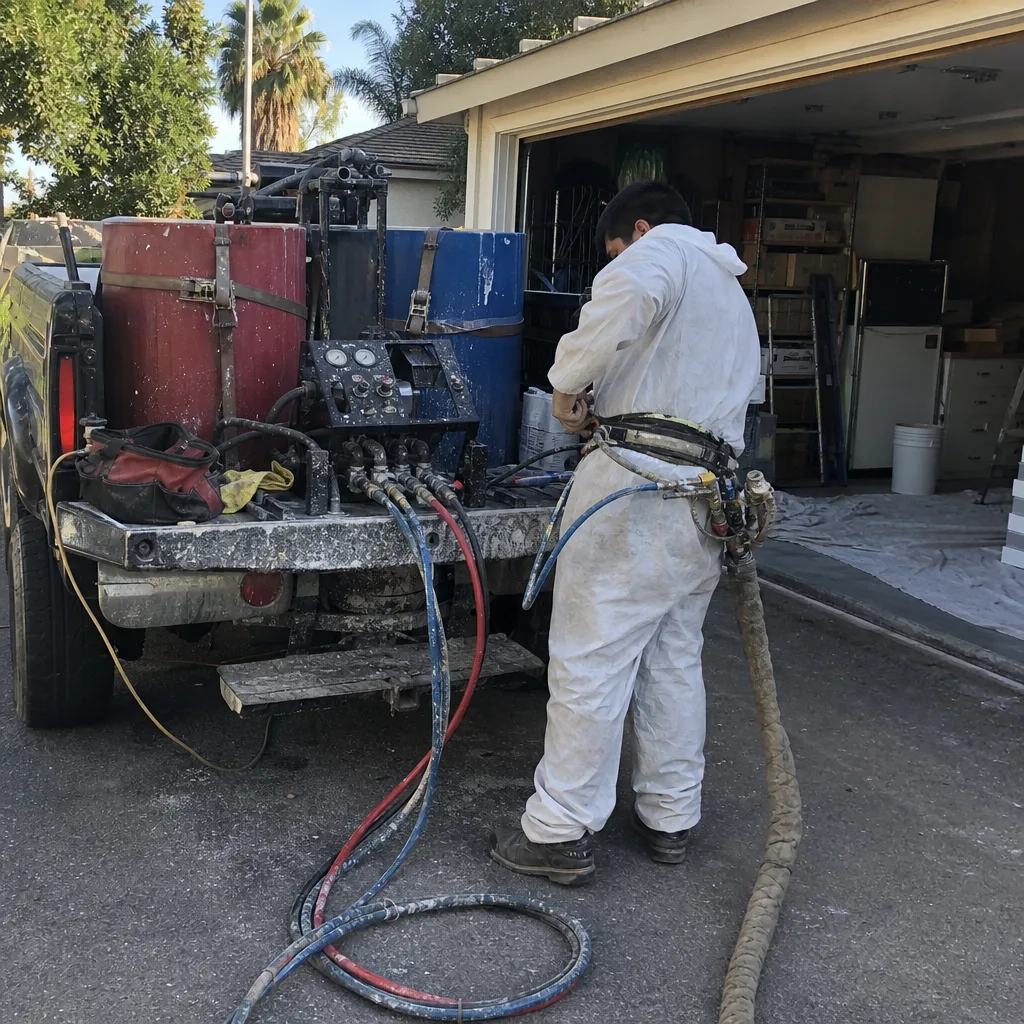
Here’s the thing about vapor barriers and Icynene specifically. Open-cell Icynene foam (the soft, sponge-like version) is air-permeable. It does a brilliant job slowing heat transfer, but it was never designed to block moisture vapor on its own. In San Jose’s climate, where winter mornings bring heavy dew and fog off the bay, that moisture moves right through open-cell foam and condenses against the cold roof sheathing. A properly installed vapor barrier stops that movement before it becomes a mold problem. That’s the part that fails, and that’s the part we replace or install correctly the first time.
Key Takeaways
- Installed vapor barrier for Icynene open-cell foam runs $1.50 to $3.25 per square foot in San Jose
- Vapor barriers fail from punctures, improper lapping, or being installed on the wrong side of the foam
- We’re an independent installer, not affiliated with Icynene, and we stock compatible barrier materials locally
- Every job gets a written price before work starts and a 365-day written guarantee
Which Icynene Models This Applies To
If you have open-cell Icynene foam in your attic or walls, this applies to you. Icynene’s open-cell lines include Classic, Classic Max, and ProSeal. The closed-cell products like ProSeal LE and MD-C-200 are dense and vapor-impermeable on their own, so they rarely need a separate barrier. Here’s the compatibility gotcha most San Jose homeowners don’t know: the Icynene warranty on some open-cell applications actually requires a vapor barrier on the warm side of the foam when installed in climates with significant temperature swings. Ours qualifies. Skipping the barrier can void portions of that warranty. If you’re not sure which product is in your attic, look for the foam’s texture. Open-cell feels like a firm sponge, closed-cell feels hard and rigid. We’ll confirm on site before quoting.
On the material side, OEM Icynene vapor barrier is quality stuff, but a few well-regarded aftermarket equivalents meet or exceed the same perm ratings. The key spec is the perm rating: you want something at or below 0.1 perms for true vapor blocking. Six-mil polyethylene rates around 0.06 perms. Certain reinforced poly barriers with foil facing rate lower still. We’ll explain the difference in plain language and give you a written price for each option before any work begins. That’s the Kingswell Way: say the price, show up in the window, leave it cleaner than you found it, and put the guarantee in writing.
Signs Your Icynene Vapor Barrier Installation Is Failing
- Musty or earthy smell in the attic or upper rooms. Moisture is getting trapped where it shouldn’t be, and mold or mildew is beginning to grow. The barrier has likely been punctured or was never installed.
- Condensation on roof decking or nails in winter. Warm, moist interior air is reaching the cold sheathing. In San Jose’s winter fog season, this shows up as visible water droplets or rust forming on nail heads.
- Peeling paint or water staining near ceiling corners and upper wall edges. Moisture is moving through the ceiling plane and collecting at the drywall edges. The barrier barrier is no longer stopping vapor migration.
- Insulation that looks damp or has settled oddly in spots. Open-cell Icynene will absorb and hold moisture when a barrier fails. You might notice darker patches or areas where the foam feels heavier than it should.
- Higher heating bills with no other explanation. Wet insulation stops insulating. When open-cell foam soaks up moisture, its R-value per inch drops measurably. Get the R-value right, and the house does the rest of the work for you.
Replacement Cost & What’s Included
For a typical San Jose attic between 1,000 and 1,800 square feet, vapor barrier installation runs $1,500 to $5,800 depending on access, existing insulation condition, and whether we’re doing a full removal and reinstall or working around the existing foam. Smaller jobs like a single wall cavity or a partial attic section start around $500. Everything is line-itemed: barrier material by the square foot, labor, any disposal of old barrier material, and cleanup. You get the exact written number before anything starts, and that number doesn’t change at the door.
What’s included: removal of the failed barrier material, inspection of the Icynene foam beneath for moisture damage, installation of new vapor barrier with properly lapped and taped seams, and a written 365-day guarantee. If it’s not right within a year, we come back and fix it at no charge. No call-back window games. Just a real person answering the phone 24/7 and a crew that shows up when we say we will.
DIY or Call Us?
You can safely inspect your existing barrier yourself. Look for visible gaps at seams, tears around plumbing penetrations, or areas where the barrier has pulled away from the framing. Checking costs you nothing and helps you describe what you’re seeing when you call us. What you shouldn’t do is attempt a replacement in a finished attic or any space where the barrier spans ceiling joists and requires working overhead with rolls of poly sheeting. The materials are affordable, but getting the lapping right, sealing around every penetration, and managing the foam beneath takes experience. A poorly seamed barrier lets moisture through at every joint, which is worse than no barrier at all because it gives you false confidence.
If you’re not sure what you’re looking at, call (669) 333-3579 and describe it to us. We’ll tell you honestly whether it’s a quick fix or a full replacement. That’s what we do in San Jose every week for homeowners who’ve been let down before. Glenn Hartley built his reputation on doing insulation work right the first time, and he’s not about to let a vapor barrier job leave this crew looking sloppy.
FAQs
A properly installed vapor barrier should last 20 to 30 years in San Jose’s climate. The failure usually isn’t the barrier material itself aging out. It’s poor installation: seams that weren’t lapped and taped, tears around wiring or plumbing penetrations, or the wrong barrier type for the foam’s perm rating. Call (669) 333-3579 and we’ll tell you exactly what failed on yours.
Small tears and punctures can often be repaired with compatible seam tape and a properly lapped patch, provided the surrounding barrier is still in good condition. Widespread seam failure or moisture-damaged areas usually warrant replacement. We’ll give you an honest assessment and a written price either way before any work starts.
A typical San Jose attic vapor barrier job takes one day. Larger homes or jobs requiring removal of wet insulation may take two. We give you a committed arrival window and we’re in and out without leaving a mess behind.
We stock Icynene-compatible vapor barrier materials on our trucks, along with barrier products that work across the other insulation brands we install: Owens Corning, Johns Manville, Knauf, Rockwool, CertainTeed, Demilec, GreenFiber, and Reflectix for radiant applications. That means same-week installation in most cases. Call (669) 333-3579 for a free estimate and we’ll let you know exactly what we’re bringing.
If you’re dealing with a damp attic or a failed vapor barrier in San Jose, call us at (669) 333-3579. We’ll give you a written price before any work begins, show up when we say we will, and put the guarantee in writing. Woolsey Attic Insulation: wool was the first insulation. Woolsey keeps the idea in the name.
Written by Glenn Hartley, Owner, Woolsey Insulation San Jose at Woolsey Insulation San Jose, serving San Jose and nearby areas.