
Demilec Crawl Space Encapsulation: The San Jose Owner’s Guide
If your Demilec crawl space encapsulation system is failing, we stock the replacement components and install them throughout San Jose, typically between $2,800 and $6,500 depending on square footage, access, and how much of the existing liner and foam needs to come out. Most Demilec encapsulation repairs in San Jose are completed in one day, and we carry the most common Demilec-compatible vapor barriers, tapes, and sealants on our trucks. You usually discover the problem the same way every homeowner does: a musty smell that creeps into the living room, or a look under the house that shows liner sagging off the foundation walls like wet wallpaper.
We’re Woolsey Insulation San Jose, and we’re an independent insulation and spray foam contractor. We install and service Demilec products, but we’re not affiliated with the Demilec corporation. Glenn Hartley runs our San Jose crew, and he’s spent decades in California attics and crawl spaces learning exactly where encapsulation systems fail and what it takes to make them hold. If you’re standing in a damp crawl space right now wondering whether this is a patch job or a full re-do, this page tells you what we’d tell you in person.
Which Demilec Models This Applies To
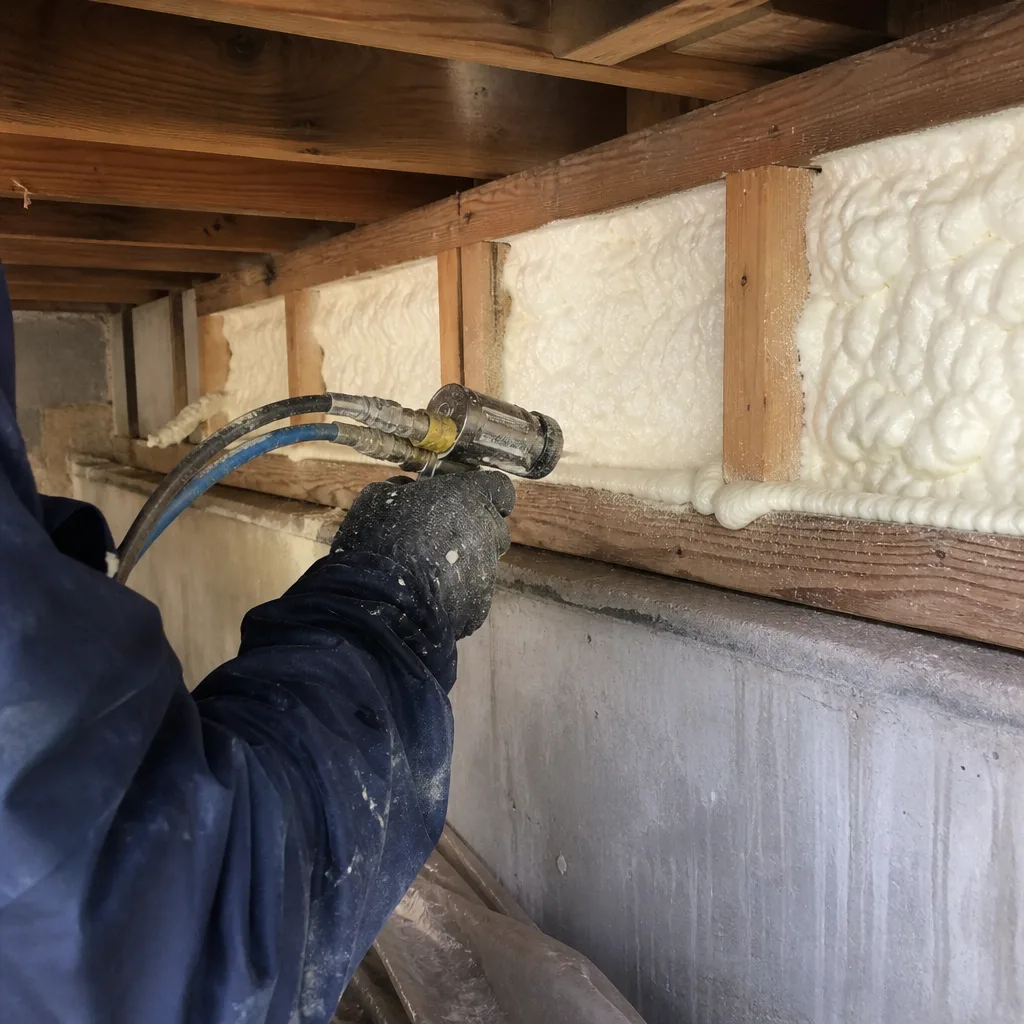
Demilec makes open-cell and closed-cell spray foam systems under a few product lines you’ve likely seen on your paperwork: Heatlok HFO, Heatlok Soya, Sealection 500, and Agribalance. For crawl space encapsulation, the product doing the heavy lifting is almost always Heatlok HFO closed-cell foam, sprayed directly onto the foundation walls and rim joists, paired with a reinforced vapor barrier laid across the floor and run up the walls.
Here’s the compatibility gotcha most San Jose homeowners don’t realize: Demilec closed-cell foam is a two-component system, and the A-side and B-side chemicals must match the exact formulation your original installer used. You can’t spot-patch Heatlok HFO with a different brand’s closed-cell foam and expect a chemical bond. The two products will delaminate, and water vapor finds the seam. We match by checking the original job paperwork, the leftover drum labels if you have them, or by pulling a small sample and testing it.
For the vapor barrier side of the system, you have more flexibility. Quality aftermarket 12-mil and 20-mil reinforced polyethylene liners perform just as well as the Demilec-branded liner when installed correctly with overlapping seams and mechanical fastening. We stock both OEM Demilec accessories (their tape, mastic, and transition membranes) and proven aftermarket equivalents, so you’re not stuck paying a premium for a logo on a roll of plastic. The honest answer: foam chemistry needs to match; barrier materials need to meet spec, not brand.
Signs Your Demilec Crawl Space Encapsulation Is Failing
- Musty or earthy smell in the house – This is the one that gets most San Jose homeowners to pick up the phone. It means humid outside air is bypassing the encapsulation system somewhere, usually at a separated wall seam or a foam-to-barrier transition point. The encapsulation is no longer airtight, so it’s not doing its job.
- Condensation on ductwork or floor joists – If the underside of your subfloor is sweating, relative humidity in the crawl space has climbed past the point where the vapor barrier and closed-cell foam can keep it in check. In San Jose’s clay-heavy soil, this gets worse after winter rains when groundwater migrates under the house.
- Foam pulling away from the foundation wall – Closed-cell foam can lose adhesion if the original installer sprayed over dusty, damp, or poorly prepped concrete. Once a section lets go, it’s a pathway for moisture and soil gases. This is the most common Demilec failure mode we see, and it’s usually an installation issue, not a product failure.
- Vapor barrier sagging, torn, or detached from the walls – High foot traffic, rodents, or improper fastening will do this. A barrier that’s not continuously sealed to the foundation wall is a decorative tarp, not an encapsulation layer.
- Rising indoor humidity or higher summer cooling bills – When the encapsulation fails, your HVAC system starts fighting crawl space air that’s carrying moisture and heat. San Jose summers are dry on the surface, but a failed encapsulation lets that moisture-laden soil airinto the conditioned envelope, and the AC works harder to remove it.
Replacement Cost & What’s Included
For a typical San Jose crawl space between 800 and 1,500 square feet, a full Demilec encapsulation replacement or major repair runs $2,800 to $6,500. The range comes down to a few things we can assess quickly: how much old foam and liner has to be removed and hauled out, whether the rim joists need spot-foaming, the condition of the foundation wall surface, and how tight the access is. Crawl spaces with 24 inches of clearance cost less to work in than ones where a technician has to do everything on his back.
Here’s how the pricing breaks down, so you’re not looking at a mystery number:
- Materials (foam, barrier, tapes, mastics): $900 to $1,800 for a typical San Jose crawl space
- Labor and prep (removal, cleaning, spraying, sealing): $1,600 to $4,200 depending on access and demolition needed
- Disposal of failed materials: $300 to $500
Every quote we give in San Jose is a written price delivered before any work starts. That’s The Kingswell Way, and it’s not negotiable: you know the full number, the arrival window, and exactly what we’re replacing before our crew parks the truck. Every Demilec encapsulation job includes our 365-Day Done Right Promise in writing. If the repair fails within a year, we come back and make it right at no charge.
DIY or Call Us?
Here’s the honest split. You can safely inspect your crawl space with a decent flashlight and check for the symptoms above: detached liner, sagging barrier, condensation, foam pulling off the wall, and visible gaps at the foundation seam. That’s worth doing once a year in San Jose, especially in early spring after the rainy season.
What you shouldn’t do is attempt a DIY repair on Demilec closed-cell foam. The two-component spray system runs through heated hoses at high pressure, and the chemicals are isocyanate-based. Improper handling means serious respiratory and skin exposure risk, and a bad DIY patch will fail in months. Even the vapor barrier replacement is work most homeowners underestimate: you need the floor graded properly, the barrier mechanically fastened and taped at every seam, and the transition to the foam sealed or you’ve just bought yourself a more expensive repair next year. If you want a professional assessment, call us at (669) 333-3579. Glenn will come out himself, look at what’s failed, and tell you plainly whether it’s a patch or a re-do. That visit and quote are free.
FAQs
Properly installed Demilec closed-cell foam and a reinforced vapor barrier should last 20 to 30 years in a San Jose crawl space. The foam itself doesn’t degrade meaningfully; what fails is usually the installation, the barrier from physical damage, or the seams from house settling. In the heavy clay soils around San Jose, ground movement is a real factor after wet winters, so we see seam separations more often than foam failures.
Yes, if the failure is localized. A section of delaminated foam, a torn barrier, or a separated wall seam can be repaired in a few hours. If the failure is widespread, which we see when the original installer skipped surface prep or used the wrong barrier fasteners, replacement is usually cheaper than chasing a dozen different failure points. Call (669) 333-3579 and Glenn will tell you which camp you’re in after one look.
Most San Jose replacements take one full day. That includes removing the failed materials, prepping the surfaces, spraying the foam, laying and sealing the new barrier, and hauling everything out. Larger crawl spaces or difficult access can push it to two days, but we’ll tell you the exact timeline in your written quote before anything starts.
We carry Demilec-compatible vapor barrier, transition tapes, and sealants on our trucks, and we source the exact Demilec foam formulation for each repair from our local supplier before we arrive. We also stock aftermarket barrier materials when they meet or exceed the Demilec spec, and Reflectix for incidental reflective insulation needs. You won’t get a “we’ll order it and come back” stall from us; the right materials are either on the truck or confirmed before we schedule your window.
Written by Glenn Hartley, Owner, Woolsey Insulation San Jose at Woolsey Insulation San Jose, serving San Jose and nearby areas.