
Johns Manville Radiant Barrier Installation: The San Jose Owner’s Guide
If your Johns Manville radiant barrier has torn, sagged, or pulled away from the rafters, we can replace or reinstall it in most San Jose homes for $1.50 to $3.00 per square foot installed, with most attics running between $1,800 and $4,200 depending on square footage and access. Most radiant barrier jobs in San Jose are done in a single day. The most common way homeowners find us: they climb up to grab holiday decorations in July, notice the foil facing is peeling or hanging in sheets, and realize the attic has been baking at 140 degrees for months.
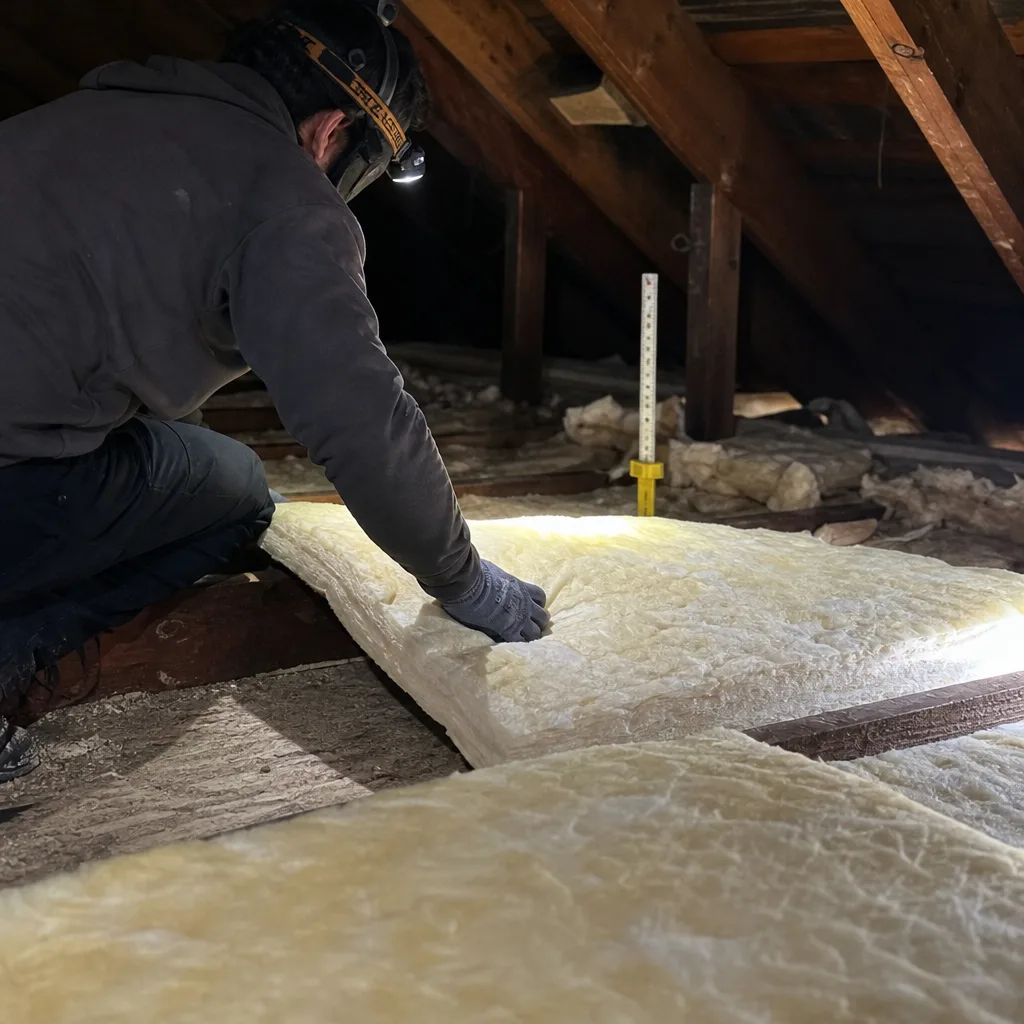
We stock Johns Manville-compatible radiant barrier material on our trucks and work with it weekly across San Jose from Almaden Valley to Berryessa. You don’t need to source the product yourself and guess at the specs. We bring it, know how it fastens to your specific rafter spacing, and we put the price in writing before any work starts.
Which Johns Manville Models This Applies To
Johns Manville makes radiant barrier in two primary configurations, and they install differently. The first is a single-sided foil laminated to kraft paper or polypropylene scrim, typically sold in 48-inch and 60-inch rolls. The second is a double-sided foil product used where the barrier needs to reflect from both directions, common in San Jose homes with ductwork running through the attic. Both types are staples or button-cap nailed to the underside of rafters, never laid flat over insulation.
The compatibility gotcha most San Jose homeowners miss: Johns Manville radiant barrier is not the same as insulation, and it doesn’t have an R-value. If your previous installer buried it under blown-in fiberglass or laid it over the attic floor, it stopped working. Radiant barrier only reflects heat when the foil surface faces an open air space. Our crew in San Jose checks this on every job because we see it constantly in older Ranch-style homes near Willow Glen where a previous owner or handyman made exactly that mistake.
For OEM versus aftermarket: Johns Manville’s radiant barrier is a commodity product in terms of performance. A quality aftermarket alternative like Reflectix performs identically when installed to the same spec. We work with eight insulation brands including Johns Manville and Reflectix, so we’ll tell you honestly when the brand name matters and when it doesn’t.
Signs Your Johns Manville Radiant Barrier Installation Is Failing
- Sagging or detached foil sheets. Staples pull out of rafters over time, especially in San Jose’s dry summer heat cycles. Once the barrier hangs even a few inches, the reflective air gap collapses and it stops doing its job.
- Tears at seam overlaps. The thin foil edge tears where two rolls were overlapped and stapled. Heat expansion and contraction works the staples loose, and the seam starts flapping.
- Visible dust coating on the foil. Dust settles on the reflective surface and cuts reflectivity dramatically. A dull, hazy foil is reflecting a fraction of what it did new.
- Upstairs rooms running 10-15 degrees hotter. When the radiant barrier fails, your attic heat loads transfer faster into the living space below. If you’ve noticed a bedroom over the garage becoming unbearable by 3 p.m., that’s usually the cause.
- AC running longer with no change in thermostat setting. The system compensates for attic heat gain added to the home’s cooling load. It’s a slow failure, but your electric bill tells the story.
Replacement Cost & What’s Included
Most radiant barrier replacement work in San Jose runs between $1.50 and $3.00 per square foot of attic area. A 1,200-square-foot attic lands around $1,800 to $3,600 installed. Two-story homes with tight access, low-slope roofs, or attics full of stored belongings push toward the upper end because the crew moves slower and works around more obstructions.
That installed price includes removal and disposal of the failed barrier, new Johns Manville-compatible foil or Reflectix material, all fasteners, and a clean workspace when we’re done. You get a written price before we touch anything, and the work is covered by our 365-Day Done Right Promise: if it’s not right within a year, we come back and make it right at no charge, in writing.
DIY or Call Us?
You can honestly inspect a radiant barrier yourself. A flashlight and a quick trip up the attic ladder will show you whether the foil is attached, torn, or dusted. But the installation itself belongs with a crew. Attic work in San Jose summers means working in temperatures that regularly push 130 degrees. Navigation between trusses while handling 60-inch foil rolls in tight spaces leads to falls, busted drywall, and punctured ducts.
That said, the honest split: a determined homeowner with a flat, tall attic and mild weather can staple barrier to rafters over a weekend. But most San Jose attics are low, hot, and full of cross-bracing. That’s where the $1.50 a square foot stops looking like an expense and starts looking like a bargain. If you’d rather skip the heat stroke and the trip to the ER, call (669) 333-3579 and we’ll give you a straight number.
FAQs
A properly installed radiant barrier lasts 15 to 20 years in San Jose’s climate. The failure point is almost never the foil itself; it’s the fasteners losing grip through repeated heat expansion and contraction cycles. Dust accumulation over a decade also cuts reflectivity. Call (669) 333-3579 if yours looks dull or detached and you want an honest assessment.
Yes, small tears and a few loose staples can be patched and refastened, and we do that kind of spot repair regularly. If more than roughly 30% of the barrier has detached or the foil is heavily dusted, replacement costs less than piecemeal repair. We’ll tell you which one makes sense for your attic.
Most single-family homes in San Jose are done in four to six hours, including removal of the old material. Two-story homes with vaulted or complex attic spaces can run into a second morning. We give you a committed arrival window and that window holds.
We keep Johns Manville-compatible radiant barrier and Reflectix on hand and we arrive with what the job needs. You don’t order anything yourself. When you call for an estimate, we confirm the square footage, the rafter spacing, and the material, then bring it on install day.
Written by Glenn Hartley, Owner, Woolsey Insulation San Jose at Woolsey Insulation San Jose, serving San Jose and nearby areas.